will also result. Ineffective compression occurs when
the elbows are not locked, the rescuer is not directly
over the sternum, or the hands are improperly placed
on the sternum.
PERFORMANCE AND REASSESSMENT OF
CPR.—When one rescuer performs CPR, the ratio of
compressions to ventilations is 15 to 2, and it is
performed at a rate of 80 to 100 compressions per
minute. Vocalize: “one and, two and, three and,...”
until you reach 15. After 15 compressions, you must
give the victim two slow ventilations (1 ½ to 2
seconds). Continue for four full cycles. Quickly check
for the carotid pulse and spontaneous breathing. If
there are still no signs of recovery, continue CPR with
compressions. Reassess the patient every few minutes
thereafter.
If a periodic check reveals a return of pulse and
respiration, discontinue CPR and place the victim in
the recovery position. Continue monitoring the victim
and be prepared to restart CPR .
Two-Rescuer CPR
If there are two people trained in CPR on the scene,
one should perform chest compressions while the other
performs ventilations.
The compression rate for
two-rescuer CPR is the same as it is for one-rescuer
CPR: 80 to 100 compressions per minute. However,
the compression-ventilation ratio is 5 to 1, with a pause
for ventilation of 1 ½ to 2 seconds consisting primarily
of inspiration.
Exhalation occurs during chest
compressions.
Two-rescuer CPR should be performed with one
rescuer positioned at the chest area and the other positioned
beside the victim’s head.
The rescuers should be on
opposite sides of the victim to ease position changes when
one rescuer gets tired. Changes should be made on cue
without interrupting the rhythm.
The victim’s condition must be monitored to assess
the effectiveness of the rescue effort.
The person
ventilating the patient assumes the responsibility for
monitoring pulse and breathing.
To assess the
effectiveness of the partner’s chest compressions, the
rescuer should check the pulse during compressions. To
determine if the victim has resumed spontaneous
breathing and circulation, chest compressions must be
stopped for 5 seconds at the end of the first minute (20
cycles) and every few minutes thereafter.
NOTE: Although it has fallen out to favor
with some agencies, two-person CPR remains
a viable method of resuscitation.
CPR for Children and Infants
CPR for children (1 to 8 years old) is similar to that
for adults. The primary differences are that the heel of
only one hand is used to apply chest compressions, and
ventilations are increased to a rate of 20 breaths per
minute (once every 3 seconds). Chest compressions
are performed on the lower half of the sternum
(between the nipple line and the notch). The chest
should be depressed approximately one-third to
one-half (about 1 to 1 ½ inches) the total depth of the
chest.
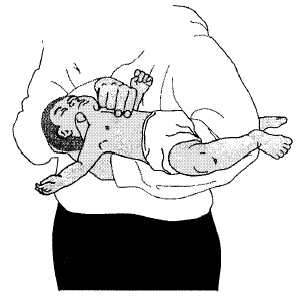
For infants (under 1 year old), CPR is performed
with the infant supine on a hard, flat surface. The hard
surface may be the rescuer’s hand or arm, although
using the arm to support the infant during CPR enables
the rescuer to transport the infant more easily while
continuing CPR. See figure 4-16. Once the infant is
positioned on a hard surface, the airway should be
opened using the head tilt-chin lift or jaw-thrust
maneuver.
Both maneuvers, however, must be
performed very carefully and gently to prevent
hyperextension of the infant’s neck. Pulselessness is
determined by palpating the brachial artery (fig. 4-17).
If the infant has no pulse and is not breathing, CPR
must be started immediately.
To perform CPR on an infant, place your mouth
over the infant’s nose and mouth, creating a seal. Give
two slow breaths (1 to 1 ½ seconds per breath) to the
infant, pausing after the first breath to take a breath.
Pausing to take a breath after the first breath of each
pair of breaths maximizes oxygen content and
4-20
Figure 4-16.—Infant supported on rescuer’s arm, and proper
placement of fingers for chest compressions.